Sunit


Sunit is a planet in the Chohi system, approximately 76 light-years from Earth. It is 0.61 times the size of Earth, with a radius of 2,415 miles / 3,886 km. It is the second closest to its star out of six planets, sitting 1.82 astral units away from Chohi.
Sunit has a similar atmosphere to Earth, albeit denser and with more oxygen and crystal particulate. It's gravity is slghtly lighter than Earth's. During the day, the sky is peach colored near the horizon, gradiating into violet and a dark blue at its highest points. At dawn and dusk, the sky is lilac, pink, and dark violet. At night, the sky is a deep blue and black like earth's.
The planet has three moons: Myodi, Mir, and Elawa. Elawa is the largest moon while Mir is the smallest. Because it has three moons, Sunit's tides are very gradual and weak most of the time. There is also a ring around the planet comprised of crystal particulate.
A Sunitian year is 448 days, with each day being 30 hours long. It has a less pronounced axial tilt than Earth, resulting in very mild seasonal variations. The planet's temperature ranges from -38 °C / -36.4 °F to 77 °C / 170.6 °F.
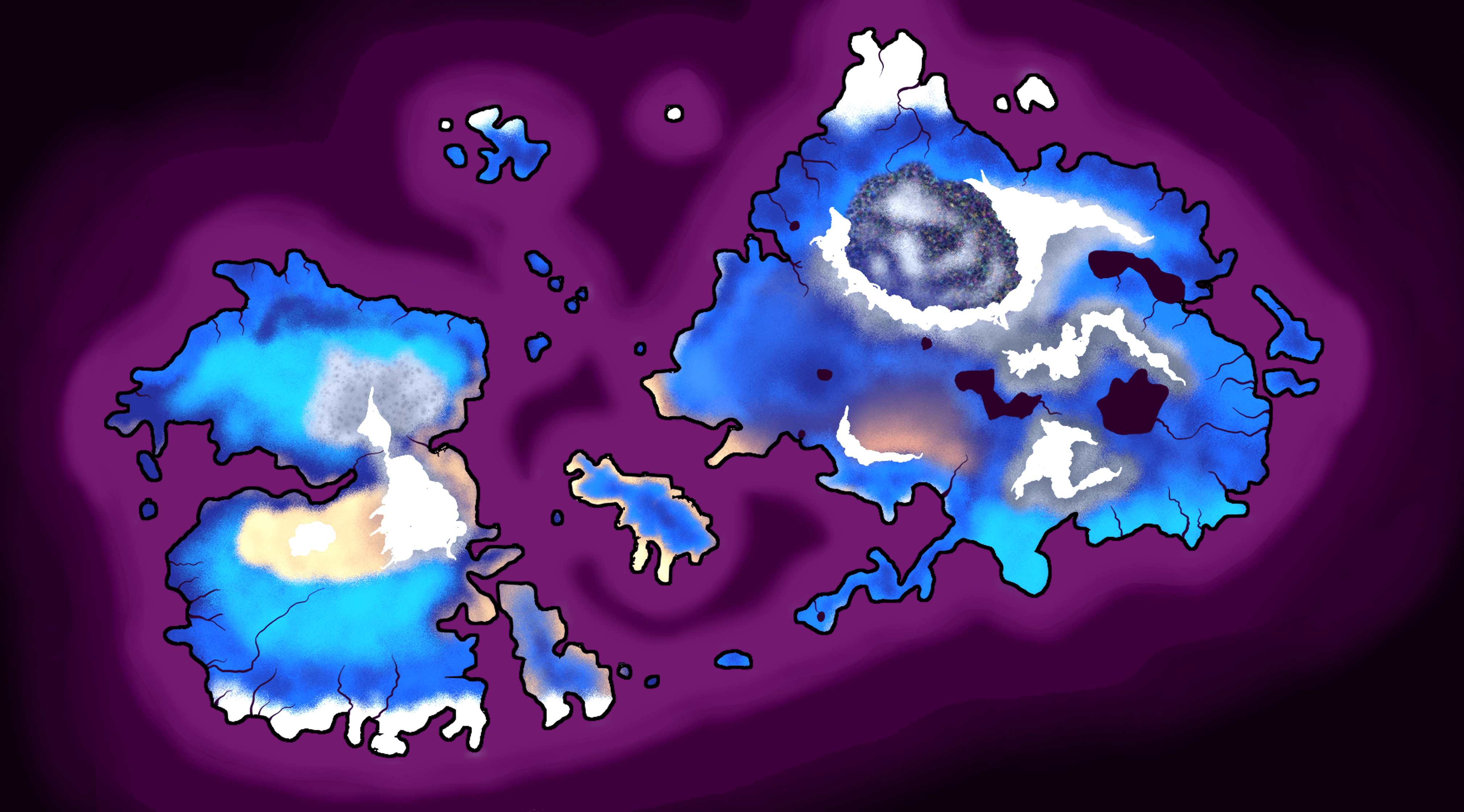

Sunit is divided into three main continents. The larger eastern continent has large impact crater in the north-central part, where the remains of the crystalline asteroid have eroded into the self-contained Glass Desert. The remnants of the asteroid form a large crystal mountain peak known as the Spire. There are three other mountain ranges on this continent from when smaller continents merged into the mainland. There are two large freshwater lakes as well as one sea. The two western continents are connected by a large mountain range, including the tallest peak on the planet, Mt. Esu. On the southwestern continent there is a massive desert with extensive plains to the south, while the northwestern continent has a large crag field extending around the northern part of the central mountains.